How PerfectTed replaced HubSpot and unified teams in Notion
PerfectTed moved from a fragmented setup, where tools and assets lived across multiple platforms and each department had its own systems, to a unified Notion workspace that fully replaced HubSpot, with standardized hubs adopted company-wide.
Client Snapshot
London, United Kingdom
2021
Consumer Packaged Goods (CPG) / Food & Beverage
100 people
Notion, Excel, HubSpot CRM, SharePoint, Teams, Outlook, Elm, Xero, Unleashed, NetStock, Otter/Fixer
PerfectTed is the world's largest matcha brand, on a mission to make matcha accessible to everyone. Founded in 2021, it has grown from a kitchen table idea to the product reaching 30,000+ stores across 50+ countries. It was named the UK's fastest-growing founder-led business and the fastest-growing retail brand in the UK (FEBE Growth 100, 2025).
PerfectTed also won investment on Dragons' Den, including backing from Steven Bartlett (see: Steven Bartlett’s Dragons’ Den Investment ‘PerfectTed’ Becomes Show’s Most Valuable Deal Ever Hitting $200m Valuation).
They're a fast-moving startup selling through UK retail, food service, international exports, and e-commerce. When they came to Optemization, they were expanding into new markets, evolving their product line, and hiring fast.
Their team of ~100 people spans Marketing, Leadership, Sales, Operations, Finance, Product Development (NPD), E-commerce, Global Markets, HR, and Business Operations. They needed a workspace that could keep up.
The Challenge
PerfectTed was scaling fast — and the systems supporting that growth were ready for an upgrade.
Each department had built up its own mix of tools over time, shaped by what was available when they needed it.
📁 Assets were "everywhere and nowhere"
Files distributed across SharePoint, Google Drive, iCloud, and personal devices. Finding the latest version of an asset often meant cross-checking with a colleague — the tools didn't make it easy to know where the source of truth lived.
👀 Zero cross-department visibility
Sales closing a new listing? Operations needed to know about packaging, volumes, and launch dates. But that info traveled by email and WhatsApp — no centralized place to check.
📊 Project management lived outside any shared system
The tools didn’t make it easy to standardize projects (templates, dependencies, capacity), so planning stayed fragmented. Marketing's annual plan lived in an Excel spreadsheet outside of Notion.
🚫 Sales had never logged into Notion
Waiting for expert help, with no workspace to call their own. The Sales hub was a blank slate — literally.
⚠️ Operations: zero adoption
A growing team tracking tasks via email, Teams, and physical notebooks. Many had never even opened Notion.
🧹 The original workspace had been outgrown
Without a centralized personal view, team members filled the gap with their own systems — notebooks, shared lists, external apps.
“We need to create a space that is very intuitive, not overcomplicated, that enables individuals and managers to get an overview of what are the projects we're focused on."
— Kelly Shaw, Head of Marketing
“From a sales perspective, we haven't had this sort of hub built yet… we've been advised to wait until we've worked with you."
— Shani Higgs, Head of Sales
How it started: The Design Sprint
Optemization kicked things off with a Design Sprint.
Over one week, the team interviewed department heads across the entire organization.
Each conversation mapped current workflows, tools, pain points, and wishlist items from the ground up. The sprint wasn't just about Notion, it was about understanding how PerfecTed actually worked: how information flowed between teams, how handoffs broke down, and where the biggest opportunities lived.
The deliverable was a comprehensive scope document with 12 recommendations ready for immediate implementation and 10 future opportunities requiring further discovery.
What Optemization built
Over 7 months, we shipped 17+ projects.
🏗️ Foundation first
Before any hubs could go live, the workspace needed a structural overhaul.
Workspace Architecture & Permissions
Cleaned up duplicate databases, established access controls and workspace governance (private teamspaces for Finance and Senior Leadership Team, ownership documentation), and reorganized the sidebar from hard to navigate to navigable.
“The idea with the Notion revamp or the new PerfectTed HQ is to have a single entry point.”
Notion Training & Onboarding
Beginner training for Ops (who'd never logged in), embedded workspace guides, and hands-on onboarding during each department rollout.
🏠 Department Hubs: Every team gets a home
The centerpiece: a series of standardized department hub rollouts. Know your way around one hub? You can navigate them all.
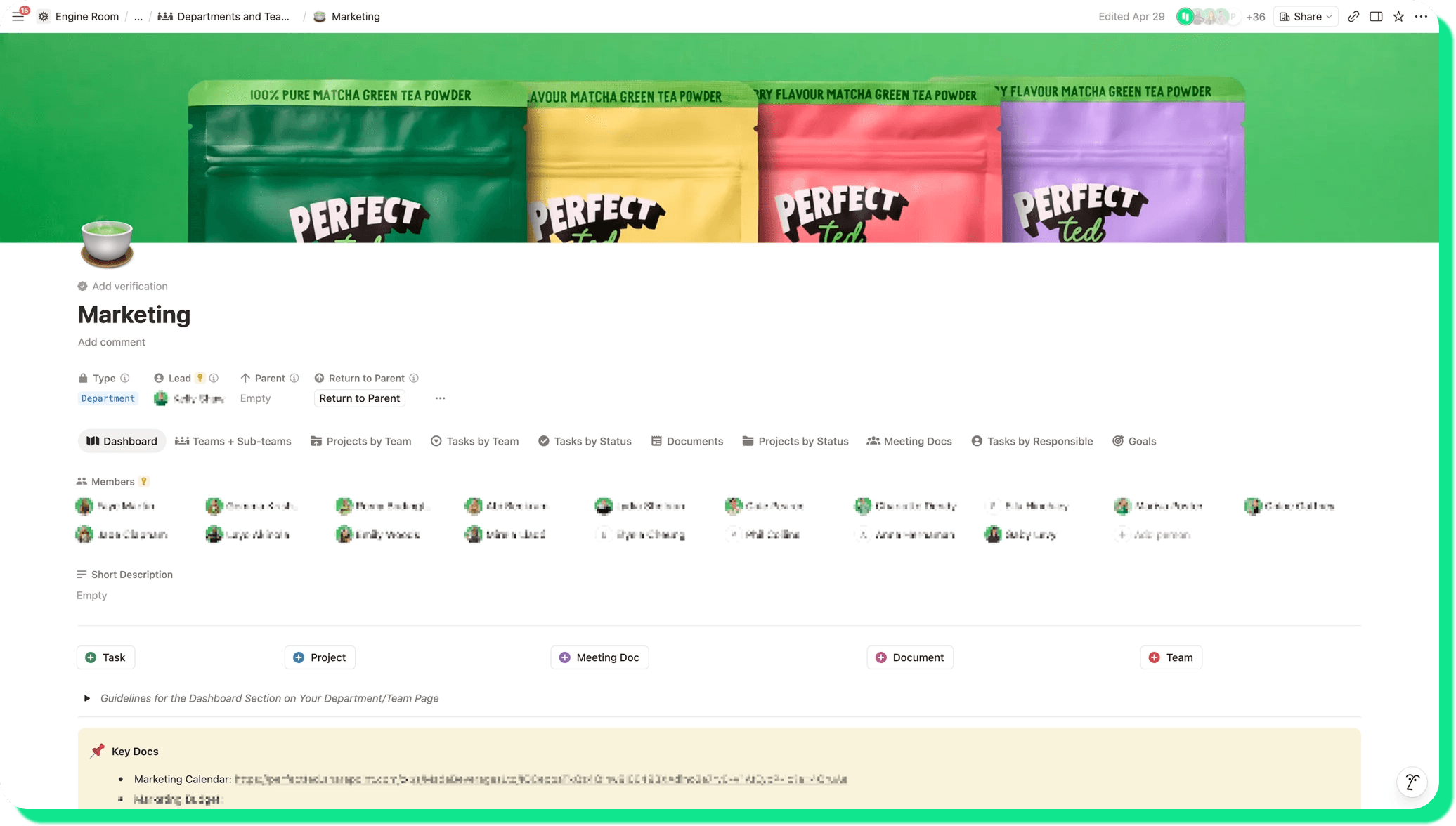
Marketing Teamspace Rollout
Rebuilt from scratch. Clean project dashboard, organized docs, sub-team areas for Branding, Campaigns, Content, and Events, plus a content calendar replacing fragmented Excel plans. Timeline dependencies adjust downstream tasks when deadlines shift.
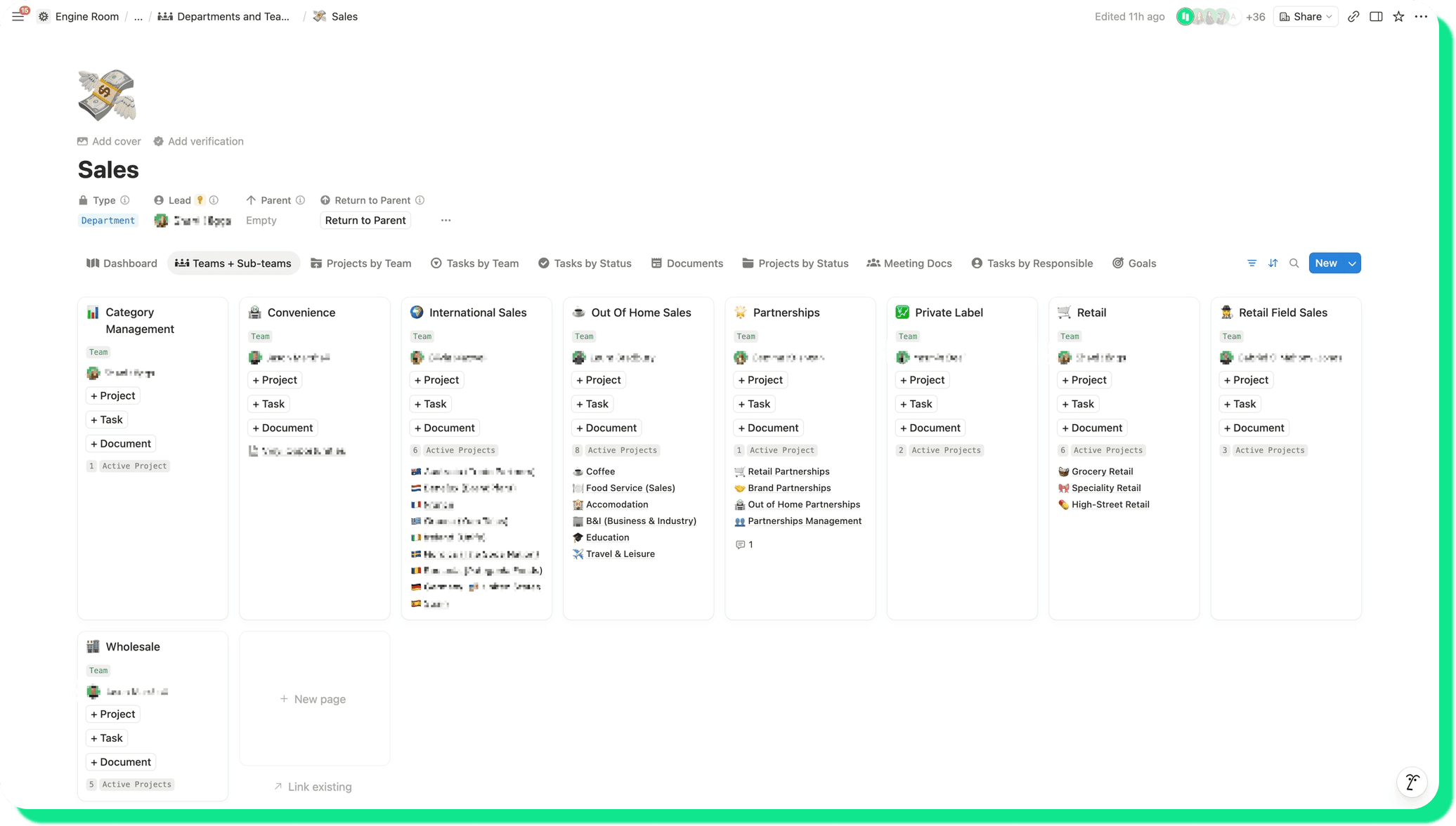
Sales Rollout
Starting with a fresh build, we structured it by channel: UK Retail, Out of Home, Export. Dead simple — account managers can track everything without overwhelm.
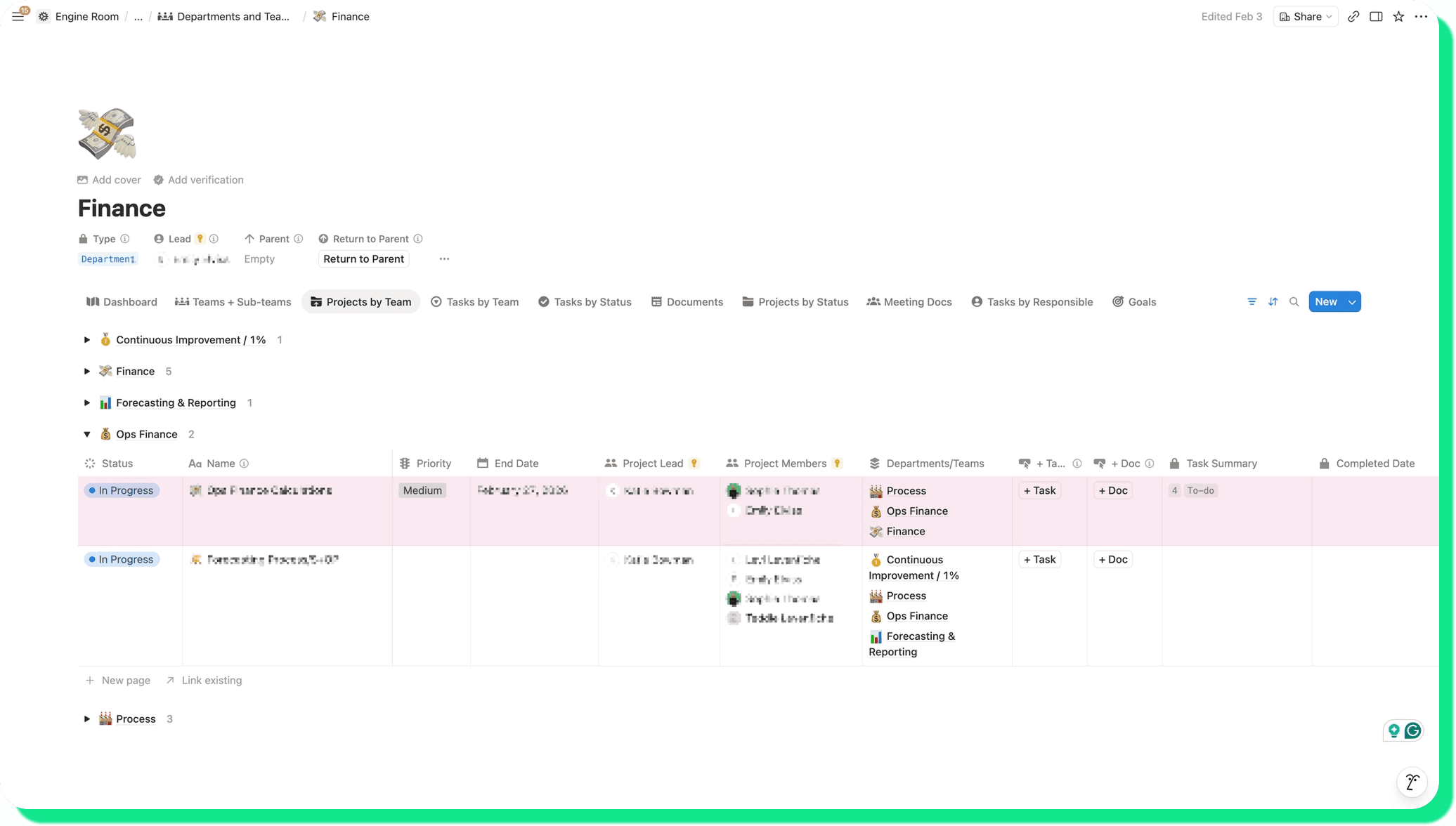
Finance Team Rollout
Finance was deployed as a fully public teamspace — a deliberate choice that matched PerfectTed's collaborative culture, with selective access controls on sensitive pages. Part of the work was change management, helping the team understand how permissions work across a shared workspace while keeping their sensitive data protected.
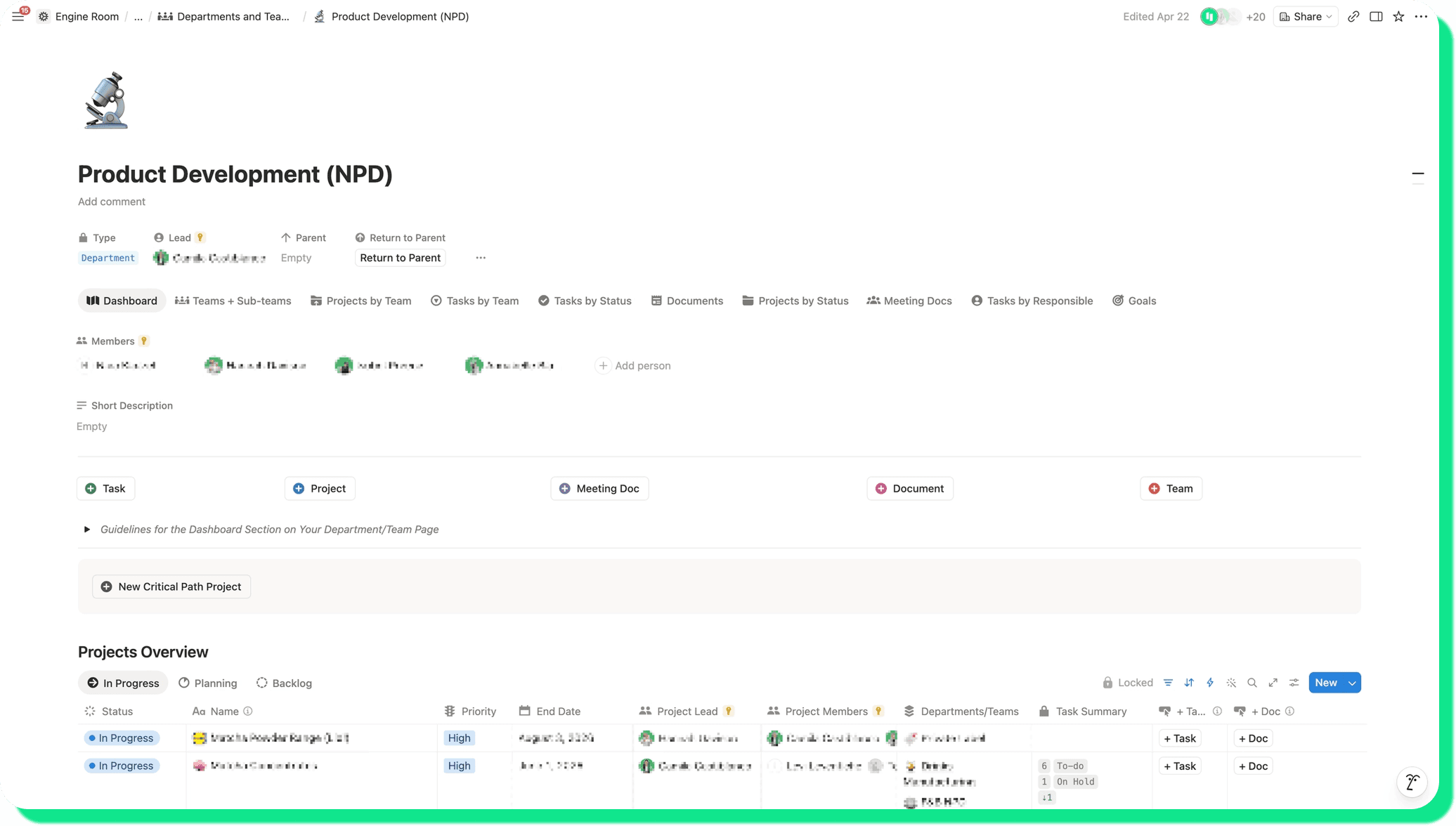
NPD Team Rollout
Product development pipeline connected to tasks across Ops, Sales, and Marketing. Every product stage visible to every team.
Leadership Rollout
High-level visibility across all departments replaced manual updates via Teams, WhatsApp, and email with a single leadership dashboard.
Ops Team Rollout
From email + physical notebooks to a fully structured hub with project management, task tracking, and cross-department communication.
Business Operations Rollout
Company-wide operational processes — policies, procedures, hiring, office requests, and team coordination — all in one hub.
⚡ Specialized Builds
Beyond the department rollouts, three standout builds became central to how PerfectTed operates: the Deals Database (a full HubSpot replacement), the Product Management Database, and the Relationship Manager. A few other targeted builds addressed specific pain points from the Design Sprint:
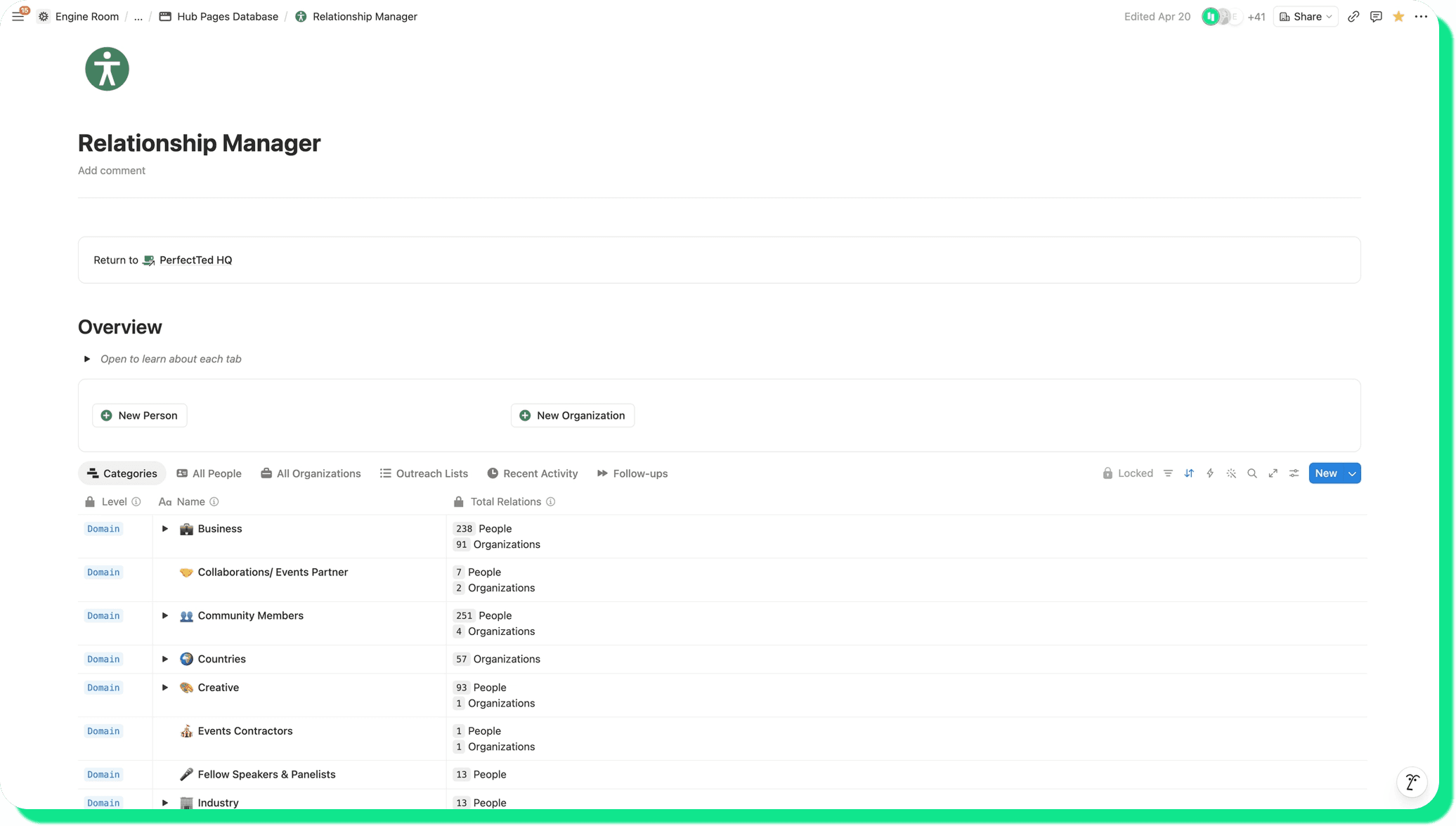
Relationship Manager
CRM-style tracking for contacts, companies, and activity history — with categorization, follow-ups, and project linking built right into Notion.
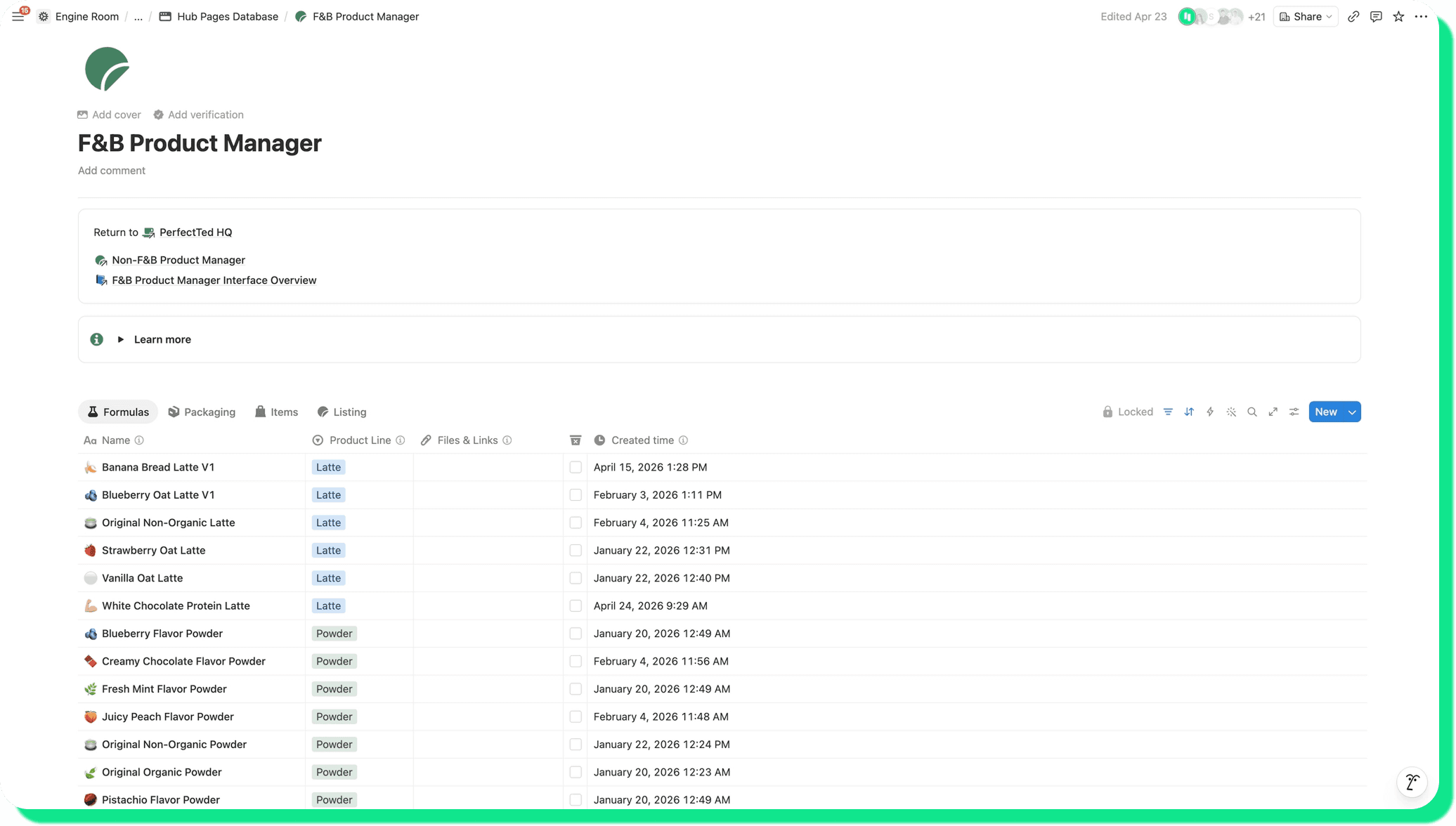
Product Management Database
Product lifecycle management connecting records to projects, tasks, and cross-functional workflows. One source of truth.
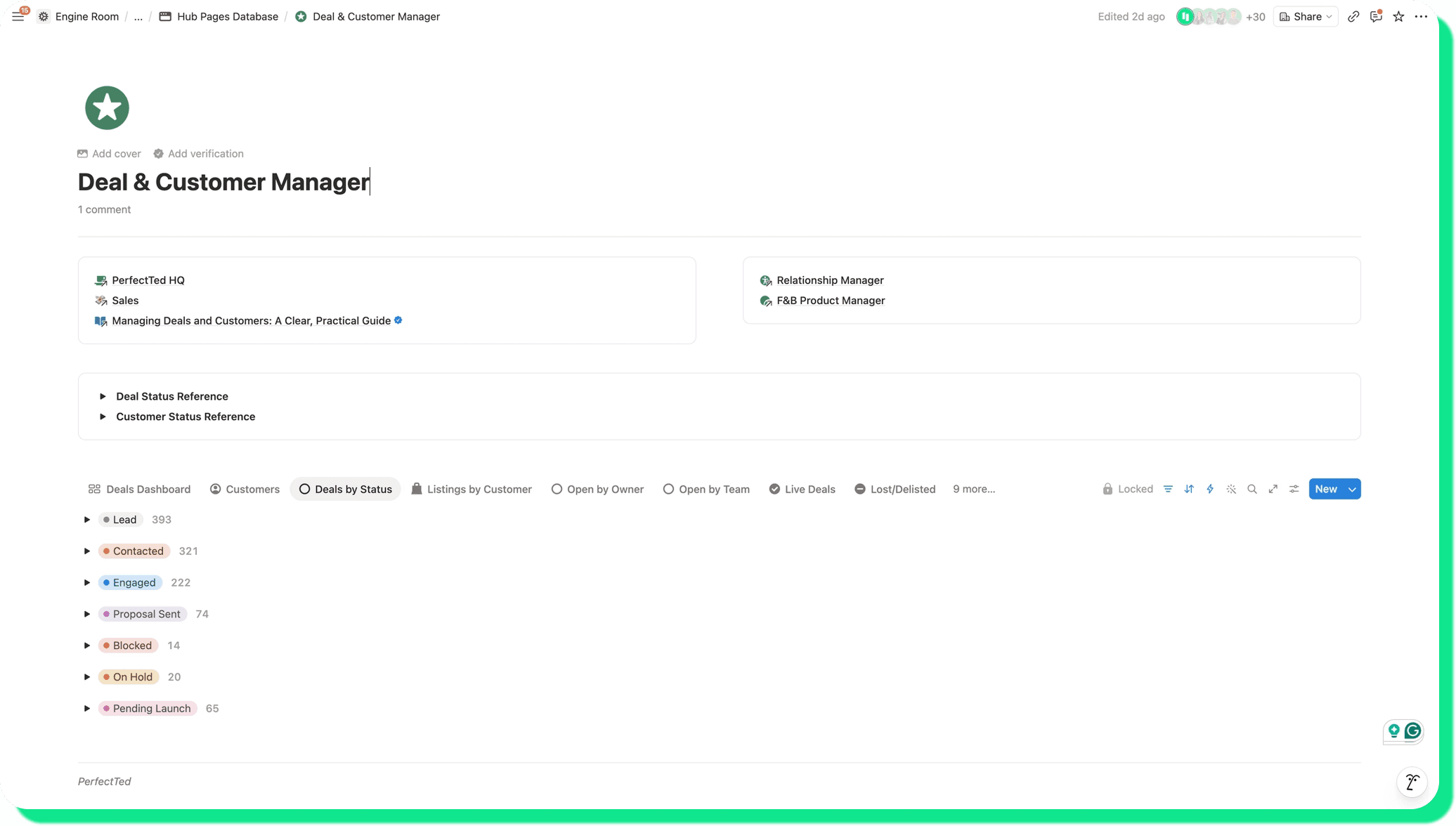
Deals Database for Sales
A full replacement for HubSpot CRM, not just a supplementary view. All active deals, contacts, and organization records were migrated into Notion from both HubSpot and previous workspace setups. Everything was tightly connected across the Sales hub, and the team responded to it really positively — one of the most well-received builds of the engagement.
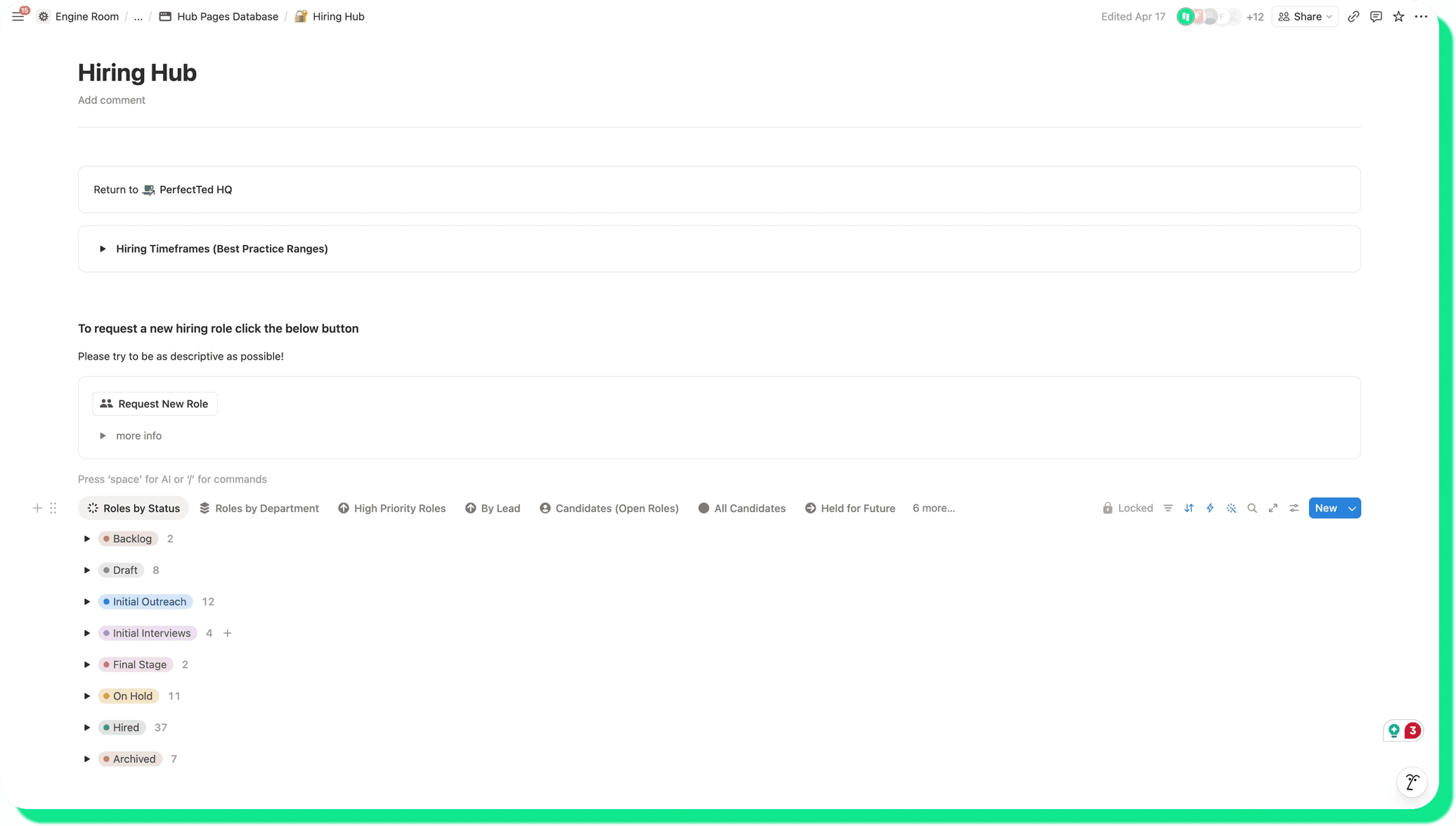
👥 Hiring & Onboarding System
Rather than building from scratch, the existing hiring and onboarding setup was reconnected to the rest of the workspace and aligned with the new permissions structure, turning an isolated tool into an integrated part of the broader system.
Housekeeping Automation
A behind-the-scenes automation that monitors pages created outside the official databases, moves them into the documents database, and nudges team members toward the right location. This quietly solved one of the team's biggest original pain points — pages getting buried in personal dashboards where no one could find them. It wasn't a formal project, but it shaped the long-term health of the workspace.
They'd been here before
Here's the thing: PerfectTed had already worked with a Notion consultant. A freelancer built their initial workspace before Optemization came in. It was a start, but as they kept growing, they quickly outgrew the solo approach.
Over time, the workspace structure didn’t scale with the company. New departments weren't set up. Sales still wasn't on Notion. And the team wanted more than fixes; they wanted a partner who could move as fast as they did.
That's when they came to Optemization, looking for an ongoing development partner that could keep up with a hyperscaling startup, not just a one-time build.
The shift from a one-time solo build to Optemization's framework meant PerfectTed finally had the infrastructure to match their ambition.
Results and impact
What they said
"Thank you so much for this, and honestly for everything you've done with the team!
It's been such a valuable process for us, and the workspace is in a really strong place now, which is a huge credit to you. The team has got so much out of it, and I know it's going to make a big difference to how we operate day-to-day.
Also just really appreciate how you worked with everyone, you made it feel easy, practical and actually usable, which isn't always the case with these things!"
— Marisa Poster, Co-Founder at PerfectTed
Looking ahead
PerfectTed now has a workspace built to scale — not just for today, but for where they're headed. As they expand into new markets, launch new products, and grow their team, the infrastructure supports it all from a single platform.
For a brand that leads the global movement in matcha, the workspace finally has the energy to keep up.
Ready to give your team a workspace that actually works?
Book a free 30-minute call with Optemization and let’s talk through what a clean Notion setup could look like for your team.