How HappyCo turned Notion into the system its whole company runs on
A fast-scaling, remote-first Series B PropTech company turned a five-year-old Notion setup into the single source of truth its team now runs on.
When HappyCo's President came to us, their Notion workspace was, in his words, "grossly out of date" and overdue for a mass overhaul. We turned that sprawl into a single, connected source of truth the whole company actually adopted, and more than a year later, we're still their trusted Notion Solutions Partner.

United States & Australia
2011
PropTech / Multifamily Real Estate Software
~240 people, remote-first across the US, Canada, and Australia
Notion, Asana, Salesforce, Jira, Slack, Google Drive
HappyCo is a property operations and maintenance platform for the multifamily housing industry. Founded in 2011, HappyCo is privately held and runs remote-first across the US, Canada, and Australia, with its software trusted across more than 5.5 million rental units.
HappyCo is moving fast. In 2025 it rolled out a major platform expansion, alongside a growing open API ecosystem that connects HappyCo to whatever property management software a customer already runs.
This is a company scaling quickly on every front: more units, more products, more integrations, and a growing global team. That pace is exactly what its internal systems needed to keep up with.
The Challenge
HappyCo had been on Notion for years, but a workspace that grew one team and one page at a time had drifted out of date, and a fast-scaling company had quietly outgrown it. The team had a lot of information stored in Notion; they just couldn't always find it.
🗂️ A five-year-old setup, out of date
HappyCo had used Notion for about five years, but the workspace had grown inconsistent and cluttered, with no company-wide structure. This made finding specific pages difficult and time-consuming for the team.
🔀 No single source of truth
Knowledge was also split across Notion, Asana, Salesforce, Jira, Slack, and Google Drive, and plenty of it got lost in Slack threads. Finding the latest version often meant asking a colleague.
🫥 Pages that vanished
New pages were created outside of databases or teamspaces and got buried in private dashboards, where the rest of the team couldn't find them.
🏃 A team moving faster than its tools
A fully remote company spread across multiple countries, HappyCo was scaling fast and needed systems that could keep up, as well as a partner who could move at their pace, not just deliver a one time build.
HappyCo didn't want a few fixes around the edges. Their President wanted a full overhaul: Notion rebuilt into a real single source of truth, run by a partner who could keep pace with a company growing this fast and support them fully.
"We use Notion, it's grossly out of date, and we need to do a mass overhaul."
— Ben Nowacky, President, HappyCo (in his first message to Optemization)
How We Rebuilt HappyCo's Workspace
🗺️ Understanding the workspace
Before changing anything, Optemization audited how HappyCo really ran: where documents lived, how each team used Notion, Asana, Salesforce, Jira, Slack, and Drive, and what was broken. From there came a plan for the new workspace, which databases it needed, how they would connect, and how to get people to actually adopt it.
🏠 Rebuild on a connected foundation
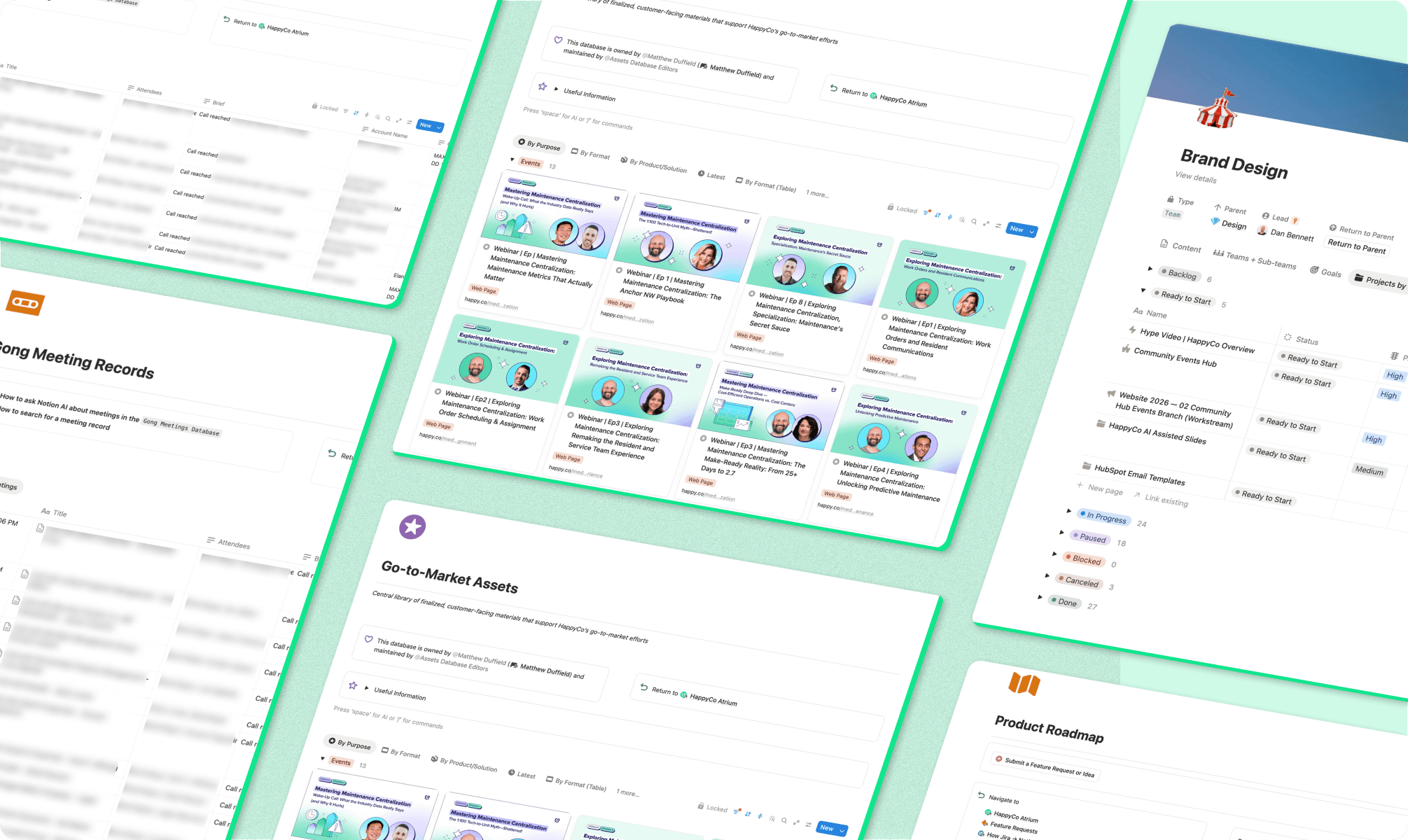
Instead of a pile of standalone pages, Optemization created a connected core: linked databases for projects, teams, documents, systems, and goals, all navigable from one place. This standardized structure keeps every team's space consistent and everything linked together, making Notion both easier to use and maintain.

🧠 Migrated the knowledge, not the clutter
Then came the long migration. Leah, our main point of contact, led a company-wide document audit. Outdated content was archived for reference, while the documents that mattered were migrated, sorted, and handed to clear owners and departments. The goal wasn't to move everything; it was to move what people actually needed and give it a home they could find.
📄 Document the "why," then roll out
Before the rollout, Optemization documented the whole system: every database, every key workflow, and the reasoning behind each design choice, so no one would feel lost. A homepage tied it all together for easy navigation. Then came the rollout, followed by another couple of months of iteration: debugging permissions, refining layouts, and gently nudging people to work in Notion instead of Slack and Google Drive.
🤝 Give every team its own system
Once the base was stable, Optemization worked team by team to make Notion their own: hiring and onboarding workflows for People, an asset library for Design, a product roadmap for Engineering that tracks features from request to release, and a full transition off Asana for Marketing, complete with the views and templates they needed.
🏠 Stay in the room
The work didn't stop at handoff. Optemization ran two company-wide Lunch & Learn sessions, one on the basics and one on AI, templates, and automation, met with Leah every week to keep the project moving, and kept a shared Slack channel open for questions.
One shift that made an impact: Optemization started running its own project work inside HappyCo's workspace, side by side with their teams, so people could see exactly how a well-run Notion setup looks in practice.
Results and impact
Over the engagement, HappyCo went from a scattered, out-of-date setup to one workspace the whole company runs on.
💯 Asana retired, Notion as the source of truth
Asana was officially sunset and the old workspaces archived. Notion became HappyCo's single source of truth, with Slack kept for real-time chat and Jira folded in where Engineering still needed it.
🤑 Value beyond the subscription
For HappyCo, the biggest gains weren't on the invoice, they were in the work. Less time lost hunting for the latest version, fewer handoffs between disconnected tools, and AI that gives better answers because it can finally see everything in one place.
📈 Adoption that kept climbing.
Task, project, and document creation rose month over month. The clearest tell: personal dashboards grew from around 20 to more than 100, a sign team members were taking ownership, not just logging in to view information.
🧹 The buried-page problem, solved.
Once every type of content had a clear home, and an automation to guide stray pages back into it, the pages that used to vanish into private dashboards became rare.
🤝 A partnership, not a project.
What began as a one-time overhaul became an ongoing relationship. More than a year later, Optemization is still HappyCo's Notion Solutions Partner as new teams and markets come online.
The strongest signal of success was the team's behavior. People kept building in Notion long after the rollout, spun up their own dashboards, and started tagging Optemization directly when they needed help. The workspace didn't just get delivered, it got adopted, and it's the kind of overhaul a fast-moving company rarely pulls off on its own.
What they said
“The Optemization team helped turn our five-year-old, inconsistent Notion setup into a single source of truth with a connected infrastructure. They acted as a true partner from conceptualization through relaunch, providing best-practice guides, hosting lunch-and-learns, and supporting Q&As as our team got up to speed. I feel our project's success was in large part due to Optemization's expertise and guidance - they made a real difference throughout.”
— Leah McMurtry, Senior Director, HappyCo
Looking ahead
HappyCo isn't slowing down. As it scales on every front, more units, an expanding API ecosystem, and new markets, it now has an internal workspace built to grow with it. New teams and departments can slot into the same structure without anyone starting from scratch.
And because this is an ongoing partnership rather than a one-time build, the workspace keeps evolving as HappyCo does, with Optemization there to support its growth. For a company moving this fast, the workspace can finally keep pace.
Has your Notion workspace become unusable?
You don’t need to start over, all you need is a reset. We keep what’s useful, fix what’s not, and untangle the mess, turning it into one connected system your team actually uses.
Book a discovery call today and let’s chat about how we can help.
Schedule a Discovery Call Today